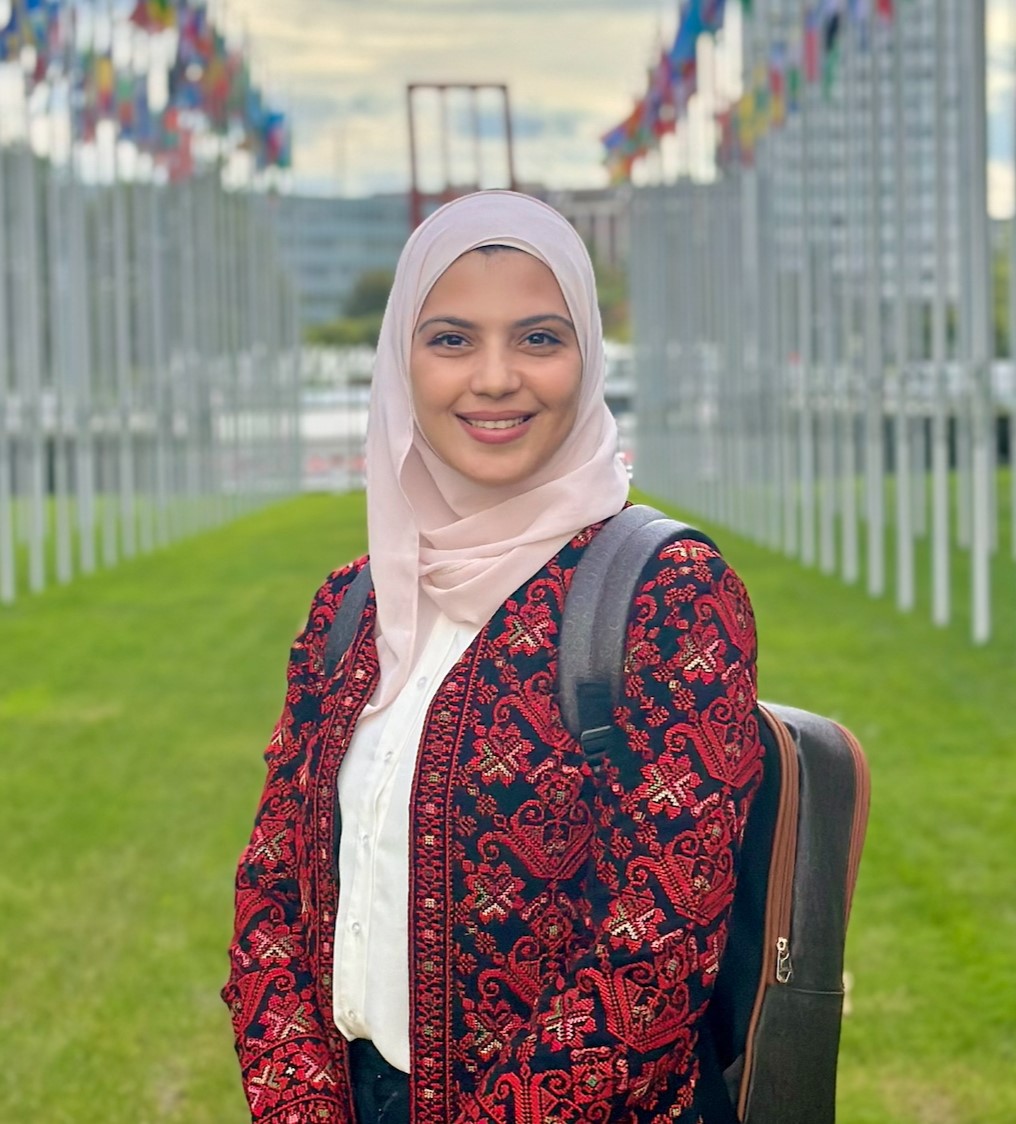
In Palestine, survival has become an everyday battle. Homes have been reduced to rubble, targets of increasing Israeli strikes; hospitals are overwhelmed, families are starving, and entire communities are forced to flee again and again, with nowhere left to go.
In the midst of this humanitarian catastrophe and decades of occupation, women have refused to disappear. Exhausted, grieving, but persistent in the face of crisis, women like Shahd Sataria continue to hold their communities together, even when systems fail and support vanishes.
Shahd, a refugee born in Jericho, is a Project Officer at the Palestinian Working Women Society for Development (PWWSD). The United Nations Women’s Peace and Humanitarian Fund (WPHF) supported PWWSD, Shahd and her colleagues – together with UN Women – to provide gender-based violence protection and psychosocial support to Palestinian women struggling to survive trauma and grief.
WPHF-supported partners like Shahd have become a lifeline for women and girls on the frontlines, delivering life-saving aid, documenting human rights abuses, providing mental health support, and legal aid to women and girls. As Gaza descended into humanitarian collapse and famine took hold, her work became far more urgent – and deeply personal.
“Gaza has always been a dream that never came true. My heart is there. My family is there. What I do for people on the ground is how I reconnect with the part of my life I’ve been separated from.”
When Gaza’s healthcare system collapsed under the strain of escalating violence and mass displacement, Shahd lost her cousin in Al-Shifa Hospital, where she was unable to receive the dialysis she desperately needed. Her story is one among thousands: wounded people unable to receive care, pregnant women losing their lives in childbirth, and children left without treatment, increasingly dying of starvation. These are victims of a healthcare system pushed beyond its limits.
“We’ve failed to protect Palestinian women. We’ve failed to stop humanitarian aid from being weaponized against them. They’ve been left to fend for themselves, stripped of their basic rights and denied the resources needed to survive.”
When others leave, women-led organizations stay
Palestinian women take initiative: whenever there’s a need, they step up to help. As Shahd explains, it is part of their nature as Palestinians: they take responsibility for helping and protecting each other instinctively, without hesitation.
This same spirit is at the heart of PWWSD, whose staff works closely with the Palestinian civilian populations they serve. That’s how they’re able to reach women even in the most difficult, high-risk areas where others often can’t. Local actors like Shahd know the needs of their communities and have their trust.
Because they’re deeply rooted in their communities, these organizations stay when others leave. When the first evacuation order came for northern Gaza, many international actors pulled out, leaving entire communities behind, without food, services, or support. But local women’s organizations continued their vital operations and stepped in to fill the gap.
“In times of war, we’re the first to respond and the last to leave – because we live here. We don’t have the privilege of walking away. This is why we need you, but you also need us on the ground. You cannot do it alone, and we cannot continue without the funding and the support to keep working.”
Since the early days of the conflict, Shahd and PWWSD were working on the ground with counselors across Gaza to provide psychosocial support and speech therapy to children who had been so traumatized by the violence that they could no longer speak. Many of these counselors were working in overcrowded homes – small spaces shared by five or six families – while bombs fell nearby.
This is what gender-sensitive humanitarian action looks like when it is led by local actors from the ground up.
From Khan Younis to Al-Mawasi in southern Gaza, PWWSD continues to create safe spaces where women and girls can come together to begin to heal. In the West Bank, in places like Tulkarem and Jenin refugee camps, they know every street, every house, every family – listening to the needs of women and girls and responding however they can.
“We don’t just participate in peace and security. We transform our communities. What you invest in us lives far beyond the project — it lives in every child who heals, every woman who rises, and every family that survives.”
Sustainable responders – but without sustainable support
At a time of deep uncertainty, when some funders questioned the presence of women’s organizations in Gaza or withdrew support entirely, WPHF continued to invest in frontline women’s groups. PWWSD was about to start its project in the West Bank focused on women’s political participation and advancing the Women, Peace and Security (WPS) Agenda in Palestine – but once the conflict escalated, that conversation became impossible.
“That’s when WPHF reached out,” said Shahd. “They not only offered to fund humanitarian response efforts, but also ensure we could sustain our office and staff,” she added.
This flexibility was critical. Many PWWDS staff members, even those in the West Bank, were displaced and overwhelmed, unsure of what to do or how long the crisis would last. The situation was even more dire for colleagues in Gaza, who were under immediate threat. It was WPHF’s rapid and flexible support, Shahd assured, what allowed them to survive, continue their activities, and be there for the women and girls who depended on them.
“The shift we need for women-led organizations is not only consulting them, but creating a meaningful partnership – and that’s what happened with WPHF. It wasn’t just a financial transaction, but a genuine collaboration where we were heard. We were able to revisit and redesign the activities based on the reality on the ground.”
But as needs grow, funding remains short-term, fragmented, and burdened by bureaucracy, leaving women’s organizations – the most sustainable responders – without sustainable support. Short-term projects, often lasting just three to six months, end abruptly, forcing them to cut off essential services that are needed now more than ever before.
Today, as the full implementation of a fragile ceasefire hangs in the balance, Shahd continues to lead, to organize, and to speak out, raising her voice on behalf of Palestinian women to advocate for long-term investment in local solutions, for recognizing the critical role women play in crisis response, and for the urgent need to ensure humanitarian action reaches those who need it most – when they need it most.
“It’s time to rethink the structure and timeline of humanitarian responses, which often exclude women’s organizations from decision-making tables and fail to reflect the rapidly changing realities on the ground. By investing in grassroots women-led organizations, you’re not just funding projects – you’re funding long-term resilience, social cohesion, and the hope of sustainable peace.”
