
New York, March 2026 — At the 70th session of the Commission on the Status of Women (CSW70), the United Nations Women’s Peace and Humanitarian Fund (WPHF) brought a clear and urgent message to the global stage: access to justice for women and girls cannot be achieved without sustained investment in women peacebuilders and women-led civil society.
As WPHF celebrated its 10-year anniversary, the UN fund convened a series of high-impact side events on the margins of CSW70 that elevated the voices of women human rights defenders, grassroots leaders, and peacebuilders from some of the world’s most fragile and conflict-affected contexts. Across these convenings, one truth resonated powerfully: peace is possible when access to justice is prioritized — and frontline women are the ones delivering it.

Centering Women on the Frontlines of Justice
At the side event “Women Human Rights Defenders Paving Pathways to Justice,” WPHF and partners spotlighted the work of the WPHF Window for WHRDs along with the lived realities of women defending rights in contexts where legal systems are weak, politicized, or weaponized.
Participants from Afghanistan, Sudan, and Kenya described justice not as a single legal outcome, but as a continuum of action — from documenting violations and supporting survivors to advocating for accountability at national and international levels.
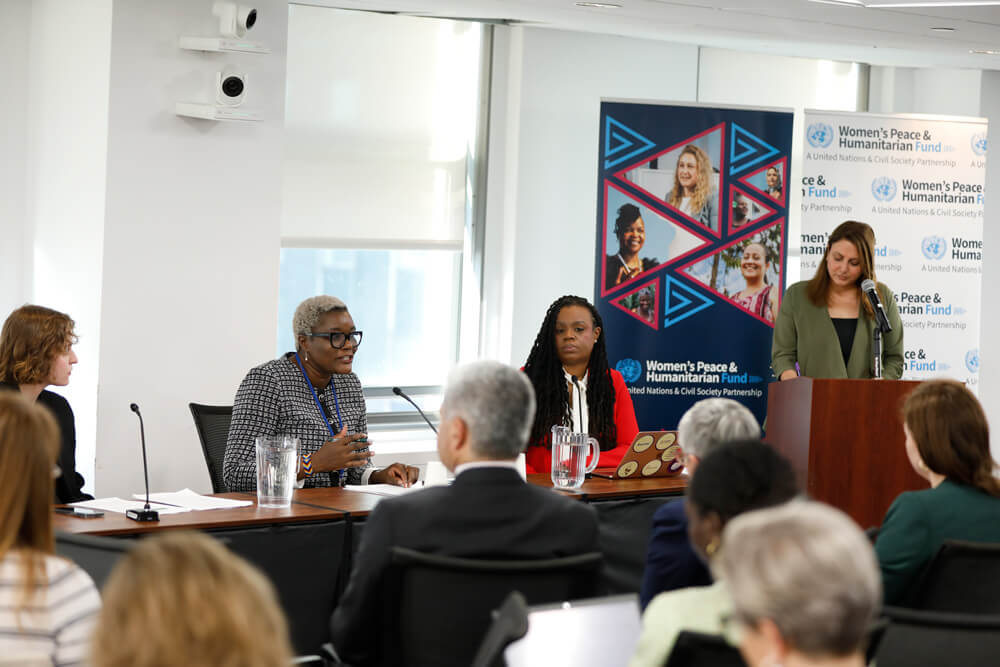
Opening the discussion, Tonni Ann Brodber, Head of Secretariat – WPHF, underscored the courage and urgency of this work:
“Women… are putting their lives on the line to make the world a safer and more peaceful place for us all… we must stand in solidarity with them and amplify their voices in delivering on the principles outlined in the UN Charter.”
These conversations reinforced a critical reframing: justice does not begin in courtrooms — it begins in communities, often carried forward by women rights defenders when formal institutions fail.
“Women Human Rights Defenders are the engines powering the ecosystem of justice and accountability, said Nargis Nehan, a former minister and WPHF Window for WHRDs-supported partner from Afghanistan. “They are the first responders raising their voices, documenting abuses, advocating for change and providing critical support to survivors through initiatives, like those funded by WPHF.”

Financing Justice: A System That Must Catch Up
At a second flagship event, “Shift Financing. Support Women. Secure Justice,” WPHF brought together governments, UN agencies, and civil society to confront a stark imbalance: while women-led organizations are often the primary providers of services in humanitarian and displacement settings, they receive only a fraction of global funding.
Brodber highlighted the scale of the gap:
“UN Women’s Global Evidence Survey1 shows that women led organizations are the key service providers in crises, and yet only 0.01% of financing today ever makes it into the hands of women led organizations. At a time when official development support is shrinking, Member States that choose to invest in women’s civil society in conflict and crisis settings demonstrates a powerful statement of solidarity. WPHF will continue to prove the value of investment in women who are delivering each day on the promise of the women, peace and security agenda.”
Speakers emphasized that justice gaps are not only the result of weak institutions, but also of financing systems that fail to reach grassroots actors. Without direct, flexible funding, local women’s organizations struggle to sustain essential services such as: Gender-based violence reporting pathways, survivor-centered legal and psychosocial support, community mediation and accountability mechanisms, and Women’s participation in decision-making
From Haiti to Ukraine to the Sahel, the evidence is clear: funding civil society organizations working alongside and led by displaced women is essential to building stability and an inclusive path to peace.
“Right now, we are in such a critical era where funding and aid is shrinking yet conflict and displacement is on the rise, said Taban Shoresh, Iraqi civil society leader and member of the Action Network on Forced Displacement. “…I really want all of us to remember that when we talk about these issues and make these requests, it comes from a place of real danger. We are risking our lives to do the work that we do, and we rely on everyone to be our allies and support us. We are on the frontlines doing the work and risking our lives – and protection for us all comes back to financing.”

Women Peacebuilders: The Architects of Sustainable Peace
WPHF’s third flagship event, “Women Shaping Sustainable Peace,” focused on the role of women peacebuilders in sustaining fragile peace processes amid ongoing conflict.
“Peace cannot be postponed until violence ends, Brodber said. “Women peacebuilders are not only participants… they are architects of peace.”
Participants from Colombia, Myanmar, Palestine, and the Democratic Republic of the Congo described how women continue to: Monitor ceasefires and document violations, advocate for inclusive peace agreements, maintain dialogue in volatile environments, and safeguard gains long after agreements are signed.
In Colombia, for example, women’s sustained advocacy helped embed gender provisions into the historic peace agreement — yet ongoing insecurity and funding gaps continue to threaten these gains.
“Today we recognize how many women are today still displaced, have been exiled, or risk suffering SGBV, said María Paula Duque Serna, a WPHF RRW-supported peacebuilder and civil society partner from Colectiva Justicia Mujer in Colombia. “It is not possible to talk about justice or peace if there are no guarantees for women’s inclusion and sustained support for the participation of women and peacebuilding organizations to shape Colombia’s future.”
Through its Rapid Response Window, WPHF has supported over 8,000 women peacebuilders across 100+ initiatives, delivering timely, flexible funding at critical moments to engage in peace processes around the world. Yet demand for support far exceeds available funding, with only 8% of eligible proposals currently funded.
A Collective Call to Action: Justice Starts in Communities
Across all events, WPHF reinforced a central insight aligned with the broader CSW70 theme:
access to justice is not only about laws or institutions — it is about who is resourced to make justice real.
In fragile settings, justice is often upheld by women on the ground: paralegals guiding survivors through inaccessible systems; frontline women’s groups documenting violations in displacement camps; community mediators creating pathways to accountability and reparations. Women and the civil society groups they lead are not peripheral — they are the justice system when formal systems collapse.
Yet global financing frameworks continue to sideline them.
As CSW70 concluded, WPHF issued a clear call: advancing justice for women and girls requires more than commitments — it requires transforming how the world funds justice.
In her closing reflections, Brodber emphasized the power of collective action:
“From local women’s organizations leading change on the frontlines to partners who make this work possible, your commitment fuels justice, protection, and peace where it’s needed most.”
Charting the Path Forward
Two decades of the Women, Peace and Security agenda have shown what works: When women are included, peace agreements are more durable; When local actors are funded, responses are more effective and trusted; and when justice systems are community-rooted, accountability and durable peace becomes possible.
As WPHF demonstrated throughout CSW70, the path to inclusive and sustainable peace is powered by communities, and through the women transforming lives within them.
Because peace is access to justice — and justice starts with women.
